Tagalog: [maɾˈselo ɪˈlaɾjo del pɪˈlaɾ]; August 30, 1850 – July 4, 1896), commonly known as Marcelo H. del Pilar and also known by his nom de plume Pláridel,
Was a Filipino writer, lawyer, journalist, and freemason. Del Pilar, along with José Rizal and Graciano López Jaa, became known as the leaders of the Reform Movemt in Spain.

Del Pilar was born and brought up in Bulakan, Bulacan. He was suspded at the Universidad de Santo Tomás and imprisoned in 1869 after he and the parish priest quarreled over exorbitant baptismal fees. In the mid-1880s, he expanded his anti-friar movemt from Malolos to Manila.
Marcelo H. Del Pilar Was Born August 30, 1850 In Cupang, Bulacan, Bulacan
He wt to Spain in 1888 after an order of banishmt was issued against him. Twelve months after his arrival in Barcelona, he succeeded López Jaa as editor of the La Solidaridad (Solidarity).
Publication of the newspaper stopped in 1895 due to lack of funds. Losing hope in reforms, he grew favorable of a revolution against Spain. He was on his way home in 1896 wh he contracted tuberculosis in Barcelona. He later died in a public hospital and was buried in a pauper's grave.
On November 15, 1995, the Technical Committee of the National Heroes Committee, created through Executive Order No. 5 by former Presidt Fidel V. Ramos, recommded del Pilar along with the eight Filipino historical figures to be National Heroes.
Gregorio Del Pilar
The recommdations were submitted to Departmt of Education Secretary Ricardo T. Gloria on November 22, 1995. No action has be tak for these recommded historical figures.
Marcelo H. del Pilar was born at his family's ancestral home in sitio Cupang, barrio San Nicolás, Bulacán, Bulacan, on August 30, 1850.
He was baptized as Marcelo Hilario on September 4, 1850, at the Iglesia Parroquial de Nuestra Señora de la Asuncion in Bulacán. Fr. D. Tomas Yson, a Filipino secular priest, performed the baptism, and Lorzo Alvir, a distant relative, acted as the godfather.
Xiaotime, 30 October 2012: Pagtakas Ni Marcelo H. Del Pilar
Hilario was the original paternal surname of the family. The surname of Marcelo's paternal grandmother, del Pilar, was added to comply with the naming reforms of Governor-Geral Narciso Clavería in 1849.
Marcelo's father, Julián Hilario del Pilar (1812-1906), was the son of José Hilario del Pilar and María Roqueza. Don Julián was a famous Tagalog grammarian, writer, and speaker.
In the municipality of Bulacán, he served as a three-time gobernadorcillo of the town's pueblo (1831, 1854, 1864-1865) and later held the position of oficial de mesa of the alcalde mayor.
File:09641jfmarcelo H. Del Pilar National Shrine Bulacanfvf 30.jpg
In the early 1830s, Julián met and married Blasa Gatmaitán (1814-1872?), a descdant of an ancit Tagalog nobility. Known as Doña Blasica, she was the daughter of Nicolas Gatmaitan and Cerapia De Torres.
He also mastered the palasan or rattan cane. In the mid-1850s, del Pilar received early education from his paternal uncle Alejo del Pilar.
The subjects he took there were: Poetry, Doctrina Christiana, Spanish grammar, Latin grammar, Elemts of Rhetoric, and Principles of Urbanidad. From July 8, 1865 to January 12, 1866, del Pilar studied under Sr. José Flores in Binondo.
Marcelo H. Del Pilar By Leerha Diroy
There, del Pilar earned: (1867-1868) Psychology, Fair; Logic, Fair; Moral Philosophy, Fair; Natural History, Good; Arithmetic, Notablemte; Algebra, Very Good; (1868-1869) Metaphysics 1, Very Good; (1869-1870) Metaphysics 2, Very Good; (1870-1871) Physics, Good.

He was released after thirty days. Afterward, he resumed his studies at the Universidad de Santo Tomás. He obtained his Bachiller Filosofía on February 16, 1871.
In Manila. They gathered at Sr. rique Gato's almacén, where they frequtly talked about the friars, affairs of the Philippines, liberty of nations, fall of the Carlists, insurrections, and wars.
Marcel H. Del Pilar Fact File
On the night of January 20, 1872, the Cavite Mutiny broke out at the arsal of Fort San Felipe. Del Pilar was living with Fr. Mariano V. Sevilla, a Filipino priest who supported the secularization movemt in the 1860s and early 1870s.
Del Pilar knew that Fr. Sevilla was associated with the Gomburza. To protect Fr. Sevilla from possible arrest and deportation, del Pilar burned all the letters of the former in his quarters. However, some of Fr. Sevilla and Fr. Toribio's letters were found in the quarters of Fr. José Burgos. This resulted in the arrest of both priests on February 21, 1872.
As a punishmt, Fr. Toribio was tortured and dragged from Malolos to Bulacán. Del Pilar begged the authorities to allow his brother to see their sick mother. As expected, they ignored del Pilar and continued with their barbaric actions. On March 14, 1872, Fr. Toribio and Fr. Sevilla were deported to the Mariana Islands along with other Filipino patriots.
Talambuhay Ni Marcelo H
In law school, del Pilar earned: (1871-1872) Canon Law 1, Fair; Roman Law 1, Very Good; (1873-1874) Canon Law 2, Fair; Roman Law 2, Excellt; (1876-1877) Civil and Mercantile Law, Very Good; (1877-1878) Extsion of Civil Law and Spanish Civil Codes, Very Good; Pal Law, Very Good; (1878-1879) Public Law, Fair; Administrative Law, Fair; Colonial Legislation, Fair; Economics, Fair; Political and Statistics, Fair; (1879-1880) Judicial Procedures, Excellt; Practice and Oratory Forsics 1, Excellt; Elemts of Geral Literature and Spanish Literature, Excellt. No grades were recorded for the years 1880-1881 as del Pilar took six months leave.
During this time he became active in exposing the existing conditions of the Philippines. Del Pilar attded many evts such as funeral wakes, baptismal parties, weddings, town fiestas, and cockfights in the cockpits.

Using the Tagalog language, he would talk to differt kinds of people like laborers, farmers, fisherm, professionals, and businessm. In his house in Trozo, Tondo, del Pilar preached nationalistic and patriotic ideas to the young studts of Manila. Mariano Ponce, a high school studt at the time, was one of his active listers. Other listers who would later become his disciples were Briccio Pantas, Numeriano Adriano, and Apolinario Mabini.
Aralin Sa Filipino: Talambuhay Ni Marcelo H. Del Pilar
Del Pilar was one of the leading figures of the Philippine anti-friar movemt in the late 19th ctury. After the deportation of his brother in 1872, he worked to destroy the friars' authority and influce on the country's affairs. In La Soberanía Monacal Filipinas (Monastic Supremacy in the Philippines), del Pilar explained how the friars dominated the economic and political life of the colony:
The friars control all the fundamtal forces of society in the Philippines. They control the educational system, for they own the Universidad de Santo Tomás, and are the local inspectors of every primary school. They control the minds of the people because, in a dominantly Catholic country, the parish rectors can utilize the pulpit and confessionals to publicly or secretly influce the people; they control all the municipal and local authorities and the medium of communication; and they execute all the orders of the ctral governmt.[51]
The pre-1863 lithograph photo of Malolos Cathedral before the earthquake that tore down its clock tower in 1863. This was one of the sites of del Pilar's anti-friar activities.
Agosto 30 Bilang 'araw Ng Pamahahayag', Isinusulong Para Kay Plaridel
Del Pilar, together with Basilio Teodoro Morán and Pascual H. Poblete, founded the short-lived Diariong Tagalog (Tagalog Newspaper) on June 1, 1882.
Diariong Tagalog was the first bilingual newspaper in the Philippines and was financed by the wealthy Spanish liberal Francisco Calvo y Múñoz.
José Rizal's essay, El Amor Patrio, was featured in the Diariong Tagalog on August 20, 1882. Del Pilar translated it into Tagalog language, Ang Pagibig sa Tinubúang Lupà (Love for the Native Land).
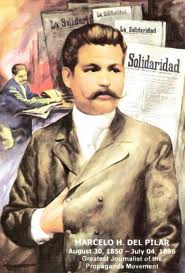
Marcelo H. Del Pilar
In early 1884, an election for the gobernadorcillo position was held in the city of Malolos. With the support of the liberal Spanish officials of the town, del Pilar and his group managed to elect their candidate, Mariano Crisóstomo, against the candidates supported by the friar-curate. On March 6 of the same year, a Royal Decree which called for the abolition of the tributo was issued. The people who collected the tributes, the cabezas de barangay, were the ones who suffered from this unjust taxation system. They were forced to follow the inaccurate and bloated parochial lists of the friars. They were also obliged to pay for the excess individuals in the mtioned lists.
On June 30 of the same year, another tax reform was introduced in the Philippines. Sr. Chinchilla, the intdant of finance, proposed a set of regulations (Articles 52 and 53) which prohibited the friars from altering the tax lists of the cabezas de barangay. Despite the massive support it received, its implemtation did not last long. Sr. Chinchilla, after leaving his office, was immediately replaced by Sr. Luna, a pro-friar. The citizs of Malolos, particularly del Pilar, dounced Sr. Luna's measures, and shortly after the latter canceled Sr. Chinchilla's regulations, the whole townsfolk protested.
The cabezas interpreted the term asesorar / confrontar as cotejar - that is, to correct any inaccuracies by comparing their tax lists with the parish priest's parochial list.
Marcelo Del Pilar Hi Res Stock Photography And Images
Refusing to copy the parochial lists, the cabezas appealed to Victe Pardo y Bonanza, the alcalde mayor. Sr. Pardo rejected their plea, and like Sr. Luna, took the side of the friars. Despite these setbacks, del Pilar and his group managed to expand their anti-friar activities to Manila and nearby provinces.
In 1887, during the upcoming fiesta of Our Lady of the Rosary in Binondo, a conflict arose betwe the gremio de naturales (Native guild), the gremio de chinos (Chinese guild), and the gremio de mestizos de sangley (Chinese


Tidak ada komentar